EpixNet documentation
Start here
Pick the path that matches what you want to do today.
-
Use EpixNet
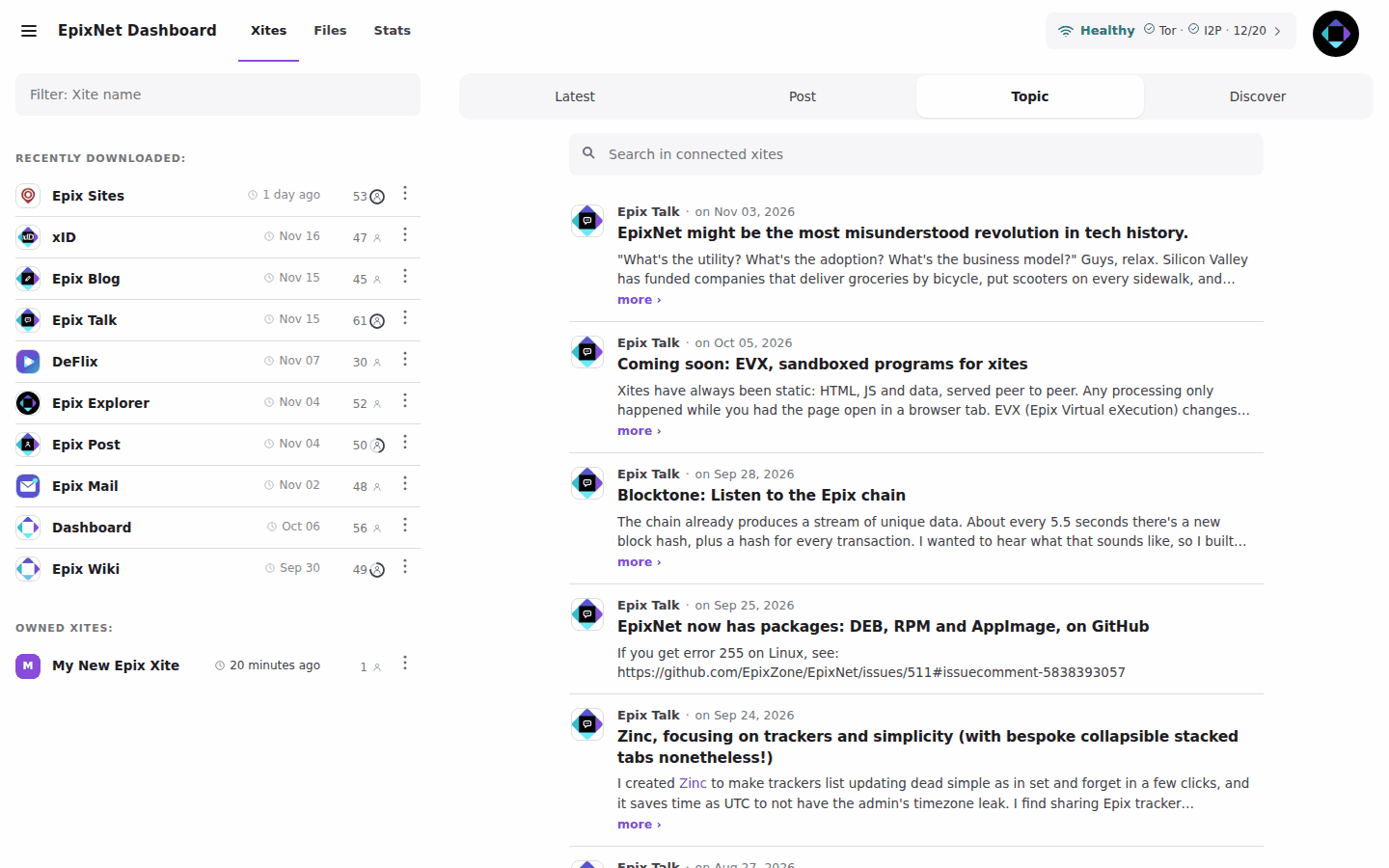
Install the node on your computer or phone, open your first xites, and learn what the dashboard shows.
-
Build a xite
Go from an empty folder to a signed, published xite with a database and user content.
-
Add web3
Connect wallets with EpixKit, call contracts on Epix Chain, and use xID names as identity.
-
Build with AI
Give your coding agent the right context and let it build xites that work on the first refresh.
Understand the platform
A xite is a folder of ordinary web files with a signed manifest. Peers that visit it keep a copy and serve it to others.
-
How EpixNet works
Addresses, signatures, peers, names, databases and routing, explained once and in order.
-
Privacy and routing
What Tor, I2P, LAN discovery and mesh transports do, and what they do not promise.
-
xID names and identity
Human-readable
.epixnames and profiles, registered on Epix Chain and verified by your node. -
Featured xites
Forum, mail, social feed, blog, wiki, video and more, all running on the network today.
Developer reference
Everything a xite can ask the node to do, and the libraries that make it convenient.
-
EpixFrame API
Every command a page can send, with parameters, permissions, return values and examples.
-
Libraries
EpixFrame, EpixKit, the React template, smart contract kits and the Epix UI kit.
-
content.json
The signed manifest that defines a xite: files, signers, permissions and user content rules.
-
Database
Map JSON files into a local SQLite database and query it from the page.
-
Sandbox and security
What a xite page can and cannot do, and how to port an existing web app.
-
Internals
Architecture, the peer protocol, EDX distribution and the xID light client.
Get involved
EpixNet is open source under the MIT License. The node, the official xites, the libraries and these docs all live in the EpixZone organization on GitHub.